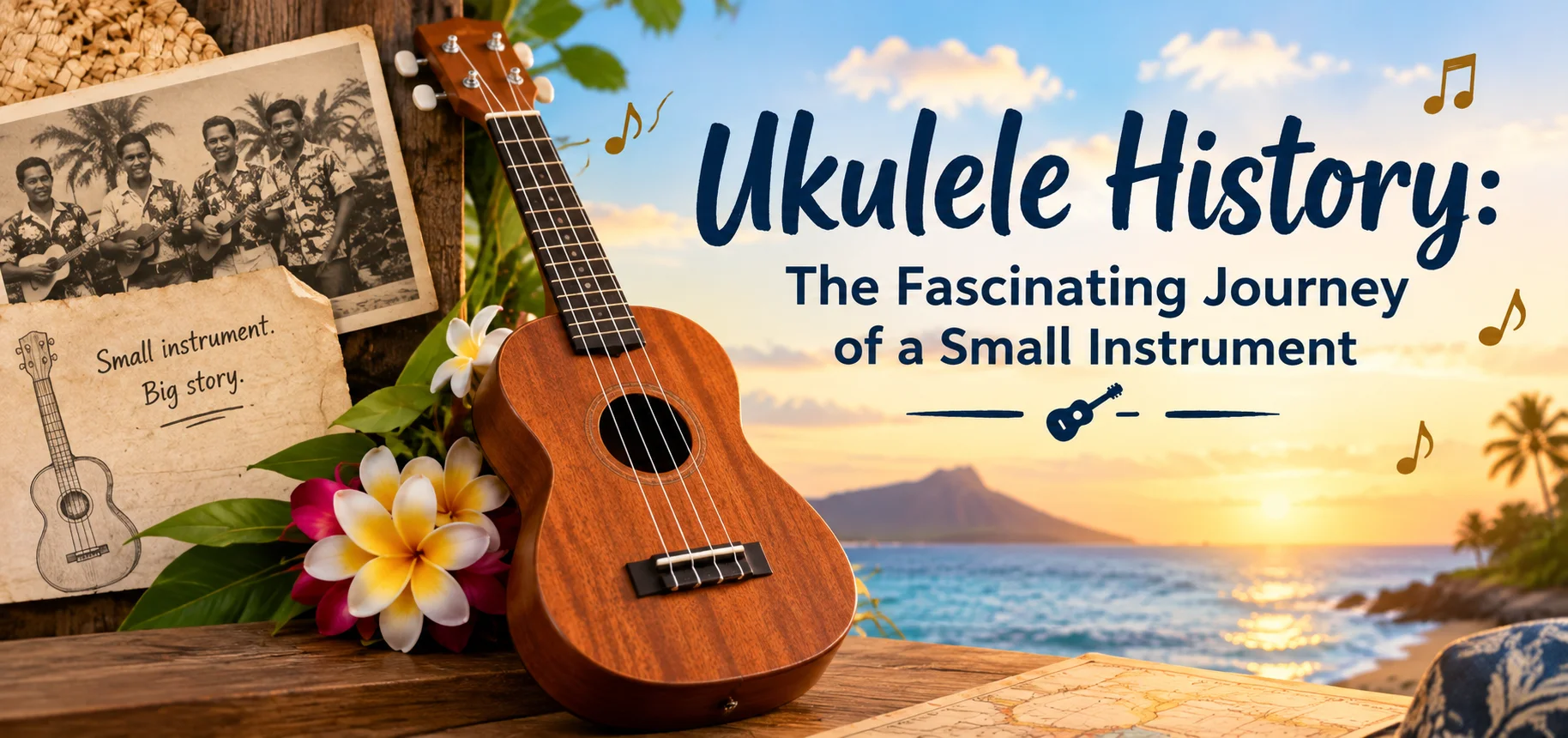
The Ukulele History is a fascinating story of cultural exchange, musical creativity, and the worldwide popularity of a small stringed instrument. Recognized for its cheerful sound, compact size, and approachable playing style, the ukulele has become a favorite among beginners, professional musicians, educators, and music lovers. Although many people associate it with the Hawaiian Islands, its origins are connected to Portuguese immigrants who brought their musical traditions to Hawaii during the nineteenth century.
Understanding the Ukulele History reveals how migration, craftsmanship, royal patronage, and technological change helped a modest instrument capture the hearts of audiences around the world. Its journey also demonstrates that an instrument does not need a complicated design or enormous size to create memorable music.
Ukulele History: The Portuguese Roots of a Hawaiian Favorite
The modern ukulele emerged in Hawaii during the late nineteenth century, but its story began much earlier in Portugal. Portuguese immigrants carried small, guitar-like stringed instruments across the ocean, introducing local communities to unfamiliar sounds and playing techniques.
The Influence of Portuguese Instruments
One of the most important instruments connected to the ukulele’s development is the machete, a small four-stringed instrument from Madeira, a Portuguese Atlantic island. Related Portuguese instruments, including the braguinha and rajão, also contributed to the musical traditions that influenced Hawaiian ukulele design.
These instruments were lightweight, portable, and suitable for lively melodies and rhythmic accompaniment. Their compact construction made them practical for social gatherings, celebrations, and informal musical performances.
Although the instruments shared similarities with the ukulele, they were not identical. The Hawaiian instrument developed its own construction methods, tuning practices, musical identity, and cultural significance after arriving in the islands.
Portuguese Immigration to Hawaii
During the nineteenth century, Hawaii’s agricultural economy attracted workers from several countries. Portuguese immigrants, particularly from Madeira and the Azores, arrived to work on sugar plantations and establish new lives.
In 1879, the Portuguese immigrant João Fernandes is widely associated with an early ukulele origin story. Historical accounts describe him playing a small Portuguese instrument after arriving in Hawaii aboard the Ravenscrag. His energetic playing reportedly attracted attention among local residents.
Portuguese instrument makers Manuel Nunes, Augusto Dias, and José do Espírito Santo also played important roles in establishing the instrument-making tradition in Hawaii. Their craftsmanship helped transform imported musical ideas into a recognizable Hawaiian instrument.
How the Ukulele Got Its Name
The name ukulele is strongly associated with Hawaii, although its precise linguistic origin is debated.
The Popular Meaning Behind the Name
One widely repeated interpretation translates ukulele as “jumping flea.” This explanation is often connected to the rapid movement of a player’s fingers across the strings.
Another account links the name to Edward William Purvis, a British officer at the Hawaiian royal court who was reportedly a small, energetic man and an accomplished player. Some historical stories suggest that his nickname influenced the instrument’s name.
However, the exact origin cannot be established with complete certainty. Hawaiian words can have multiple interpretations, and historical explanations sometimes differ.
Regardless of its precise origin, the name became internationally recognizable as the instrument spread beyond Hawaii.
Pronunciation and Cultural Identity
The Hawaiian pronunciation is commonly represented as ‘ukulele, with an initial glottal stop in Hawaiian orthography. English speakers often pronounce it as “oo-koo-leh-leh,” although pronunciations vary by region.
The name reflects more than the instrument’s physical design. It connects the ukulele to Hawaiian language, music, and cultural history, making its identity an important part of its continuing story.
Ukulele History Timeline Table
| Year/Period | Historical Event | Significance |
|---|---|---|
| Before the 1870s | Portuguese instruments such as the machete and braguinha developed in Madeira. | Established important musical influences for the ukulele. |
| 1879 | Portuguese immigrants arrived in Hawaii, bringing their musical traditions. | Helped introduce the instruments that influenced the ukulele. |
| Late 19th century | Hawaiian instrument makers began developing the ukulele. | Established its distinctive design and sound. |
| 1874–1891 | King Kalākaua supported Hawaiian music and cultural arts. | Helped increase the instrument’s cultural recognition. |
| 1915 | Hawaiian music attracted attention at the Panama-Pacific International Exposition in San Francisco. | Increased mainland American interest in the ukulele. |
| 1920s | The ukulele became highly fashionable in the United States. | Expanded its popularity in homes, schools, and entertainment. |
| Mid-20th century | The instrument appeared in recordings, stage performances, and popular entertainment. | Maintained its presence in international music. |
| Late 20th century | Hawaiian musicians and recordings renewed interest in the ukulele. | Reconnected audiences with its Hawaiian musical roots. |
| 21st century | Online tutorials, social media, and modern musicians introduced it to new audiences. | Made learning and playing the ukulele more accessible worldwide. |
The Role of Hawaii’s Royal Family
The Hawaiian royal family helped the ukulele gain recognition during its early development. Music played an important role in court life, public celebrations, and cultural gatherings, creating opportunities for new instruments to become part of the islands’ musical landscape.
King Kalākaua and Musical Innovation
King David Kalākaua, who ruled Hawaii from 1874 to 1891, was a major supporter of Hawaiian arts, music, and cultural traditions. His reign is associated with a revival of Hawaiian cultural practices during a period of significant political and social change.
The king and members of the royal court supported musical performances and artistic expression. The ukulele became associated with royal gatherings and Hawaiian entertainment, helping it gain visibility among residents and visitors.
Although the instrument’s early popularity cannot be attributed to a single individual, royal interest helped establish its place in Hawaiian musical life.
Queen Liliʻuokalani’s Musical Legacy
Queen Liliʻuokalani, Hawaii’s last reigning monarch, was a gifted composer and musician. She created numerous Hawaiian songs, including the internationally known “Aloha ʻOe.”
Her musical legacy demonstrates the depth of Hawaii’s songwriting traditions during the same broad historical period in which the ukulele was developing.
The instrument eventually became closely associated with Hawaiian melodies, but its cultural importance extends beyond a single ruler or song. It reflects a wider tradition of musical creativity and cultural resilience.
The Ukulele History During the Early Twentieth Century
By the beginning of the twentieth century, the ukulele was becoming an important feature of Hawaiian music and entertainment. Tourism, recordings, exhibitions, and popular performances helped introduce it to wider audiences.
The Panama-Pacific International Exposition of 1915
A major milestone occurred at the Panama-Pacific International Exposition in San Francisco in 1915. Hawaiian music and performers attracted substantial attention at the event, helping generate interest in Hawaiian culture across the mainland United States.
The ukulele’s bright tone, portability, and distinctive appearance made it especially appealing to audiences encountering Hawaiian music for the first time.
As interest grew, mainland manufacturers and retailers began promoting ukuleles to American consumers. Music publishers also produced instructional materials and song arrangements, making the instrument more accessible to home musicians.
The Ukulele Craze of the 1920s
The 1920s brought a significant surge in ukulele popularity. The instrument became fashionable in the United States, appearing in music stores, homes, schools, stage performances, and popular entertainment.
Its four strings made basic chord accompaniment relatively approachable, while its compact size appealed to people who wanted an instrument that was easy to carry.
Manufacturers introduced a range of models, including decorative instruments and versions made from different materials. The ukulele became a recognizable feature of the decade’s popular culture.
However, its popularity eventually declined as musical fashions changed and other instruments became more prominent in commercial entertainment.
Understanding the Main Types of Ukulele
As the instrument developed, manufacturers produced several sizes with different tonal characteristics. Each type offers a slightly different playing experience.
Soprano Ukulele
The soprano is the traditional, compact size often associated with the classic ukulele sound. Its bright, lively tone makes it popular among beginners and musicians who enjoy a lightweight instrument.
Because the frets are relatively close together, players with larger hands may need time to become comfortable with its dimensions.
Concert Ukulele
The concert ukulele is slightly larger than the soprano. It generally offers more space between frets and a somewhat fuller sound while retaining the instrument’s characteristic brightness.
This size can be an appealing option for players who want a compact instrument with a little more room for their fingers.
Tenor Ukulele
The tenor ukulele provides a larger body and longer scale. Depending on its construction and strings, it can produce a fuller, richer sound that works well for fingerstyle playing, instrumental melodies, and performance.
Many experienced players appreciate its additional fretboard space.
Baritone Ukulele
The baritone is the largest of these four common sizes and usually has a deeper, warmer tone. Its standard tuning, D–G–B–E, matches the highest four strings of a guitar, making it especially familiar to some guitar players.
How the Ukulele Spread Around the World
The instrument’s global success was not limited to the United States. International travel, recorded music, education, and popular entertainment introduced it to audiences across several continents.
Growth Through Music and Entertainment
During the twentieth century, the ukulele appeared in stage shows, films, radio broadcasts, and recordings. Musicians used it in a variety of settings, from traditional Hawaiian performances to comedy, folk, and popular music.
Its portability made it practical for touring performers and informal musical gatherings. Its distinctive tone also helped it stand out in recordings and live performances.
As mass-produced instruments became more accessible, people could explore music without investing in a large or expensive instrument.
The Ukulele in Britain and Beyond
The ukulele gained followers in Britain and other countries through touring performers, imported instruments, and popular music. British entertainers helped keep the instrument visible during periods when its popularity elsewhere fluctuated.
Over the decades, the ukulele became established in community music programs, schools, clubs, and home practice routines. Different countries developed their own approaches to playing it, combining local musical traditions with familiar ukulele techniques.
This international growth transformed the instrument from a regional Hawaiian favorite into a versatile musical tool.
The Modern Ukulele Revival
The ukulele experienced renewed popularity in the late twentieth and early twenty-first centuries. Online videos, accessible learning resources, contemporary recordings, and social media introduced the instrument to a new generation.
Famous Performers and Memorable Recordings
Musicians such as Israel Kamakawiwoʻole helped bring renewed attention to Hawaiian music and the ukulele. His medley combining “Somewhere Over the Rainbow” with “What a Wonderful World” became internationally recognized and introduced many listeners to his gentle musical style.
Other performers explored the ukulele through jazz, instrumental arrangements, indie music, and experimental styles. Their work challenged the idea that the instrument was limited to simple accompaniment or novelty performances.
Modern ukulele players can use fingerpicking, harmonics, rhythmic patterns, and advanced chord voicings to create expressive performances.
Digital Learning and Online Communities
Online tutorials and virtual communities have made learning the ukulele more accessible. Beginners can find lessons covering tuning, basic chords, strumming patterns, finger placement, and song arrangements.
Schools and community organizations also use the instrument in group lessons because its compact design and approachable fundamentals can encourage musical participation.
Nevertheless, progress still requires regular practice. Developing clean chord changes, consistent rhythm, and accurate tuning takes patience, even on a small instrument.
Five Fascinating Facts About Ukulele History
- Portuguese influence: The ukulele developed from musical traditions associated with Portuguese immigrants and their small stringed instruments.
- Hawaiian craftsmanship: Portuguese-born instrument makers helped establish the ukulele-making tradition in Hawaii.
- Royal connections: King Kalākaua’s support for Hawaiian arts helped create a cultural environment in which the instrument gained recognition.
- International exposure: Hawaiian performances at the 1915 Panama-Pacific International Exposition helped popularize the instrument on the American mainland.
- A modern comeback: Online tutorials, contemporary performers, and affordable instruments have helped the ukulele attract new players around the world.
Why the Ukulele Remains Popular Today
The ukulele’s enduring appeal comes from a combination of practicality, expressive sound, and cultural significance. It is relatively lightweight, easy to transport, and capable of producing both simple accompaniment and sophisticated arrangements.
For beginners, learning a few basic chords can provide an encouraging introduction to music. More experienced musicians can explore complex rhythms, melodic improvisation, and fingerstyle techniques.
Its popularity also reflects the emotional connection people form with music. A ukulele can accompany a quiet personal performance, bring friends together at a gathering, or support a lively stage show.
Frequently Asked Questions
1. Where did the ukulele originate?
The ukulele developed in Hawaii during the late nineteenth century, influenced by small Portuguese stringed instruments brought by immigrants.
2. Who invented the ukulele?
There is no single confirmed inventor. Portuguese-born instrument makers, including Manuel Nunes, Augusto Dias, and José do Espírito Santo, helped establish its early development in Hawaii.
3. Why is it called a ukulele?
The name is Hawaiian and is commonly interpreted as “jumping flea,” although its precise origin remains debated.
4. When did the ukulele become popular in America?
Hawaiian performances at the 1915 Panama-Pacific International Exposition helped spark widespread American interest, followed by a major popularity surge during the 1920s.
5. Which ukulele size is best for beginners?
Soprano and concert ukuleles are popular beginner choices. The best option depends on hand comfort, sound preference, and playing style.
Final Thoughts
The Ukulele History is a remarkable journey from Portuguese musical traditions to the vibrant cultural landscape of Hawaii and, eventually, the global music scene. Its development demonstrates how migration, skilled craftsmanship, royal patronage, international exhibitions, and modern technology can transform a small instrument into a worldwide favorite.
From the early work of Portuguese instrument makers to the popularity of Hawaiian performers and contemporary musicians, every stage contributed to the ukulele’s distinctive identity. Its four strings and compact body may appear simple, but the instrument offers extraordinary musical possibilities.




2 thoughts on “Ukulele History: The Fascinating Journey of a Small Instrument”