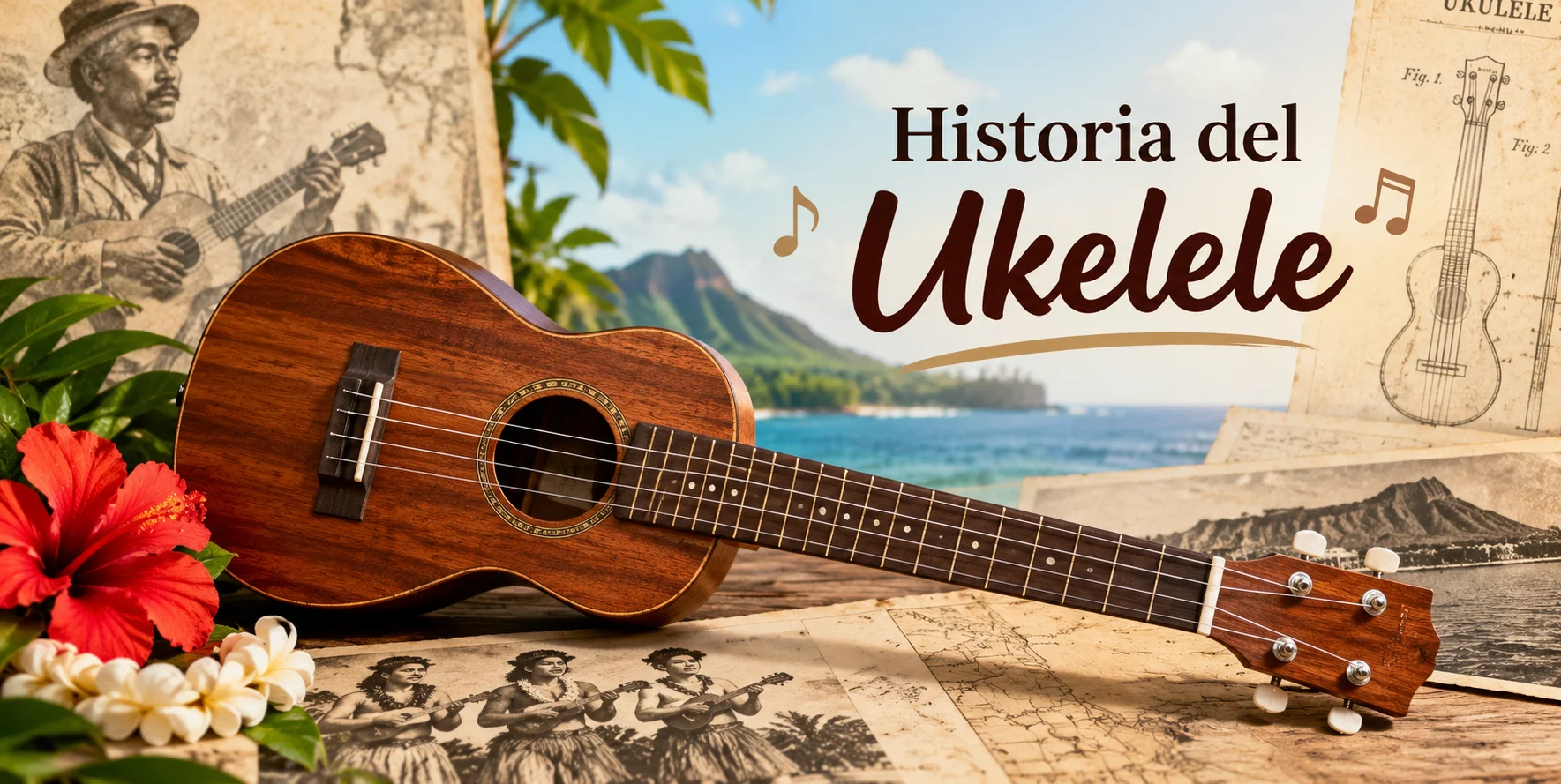
The Historia del Ukelele is a fascinating story of migration, craftsmanship, cultural exchange, and musical creativity. Although the instrument is strongly associated with Hawaii, its roots can be traced to Portuguese string instruments brought to the Hawaiian Islands by immigrants from Madeira during the late nineteenth century. The small instrument eventually developed into a distinctive part of Hawaiian culture before spreading around the world.
The ukulele became popular because of its compact size, cheerful tone, simple construction, and expressive sound. Its history shows how an instrument can travel across oceans, change through local craftsmanship, and become something new while still preserving elements of its earlier identity.
From Portuguese folk traditions to Hawaiian royal gatherings and modern international music, the Historia del Ukelele contains several important stages. Understanding those stages makes the instrument even more interesting for musicians, collectors, students, and anyone curious about musical history.
Portuguese Roots of the Ukulele
The earliest chapter in the Historia del Ukelele begins with small stringed instruments associated with Portugal and Madeira. Before the modern ukulele existed, musicians in these regions played compact instruments such as the machete or braguinha, rajão, and related guitar-like instruments.
The machete was particularly important because its compact body, four-string arrangement, and playing style closely resemble important features of the later Hawaiian ukulele. The rajão also contributed to the musical development that eventually influenced ukulele tuning.
The Machete and Braguinha
The machete, sometimes referred to as the braguinha or machete de Braga, was a small Portuguese string instrument. Its size made it practical for social music and everyday performances.
When Portuguese immigrants traveled to Hawaii, instruments from their homeland traveled with them. These musical traditions provided the foundation from which Hawaiian instrument makers developed a new form.
The Role of Madeira
Madeira played an important role in the story because many Portuguese immigrants who settled in Hawaii came from the island. Their cultural traditions included music, craftsmanship, food, language, and community celebrations.
The arrival of these traditions created an unexpected musical exchange. Portuguese instruments entered Hawaiian society, where local musicians and craftsmen gradually adapted them to their own environment.
The Ukulele Arrives in Hawaii
| Historical element | Important detail |
|---|---|
| Main European roots | Portugal and Madeira |
| Major arrival period | Late 19th century |
| Important year | 1879 |
| Ship associated with the arrival | SS Ravenscrag |
| Early makers | Manuel Nunes, Augusto Dias, José do Espírito Santo |
| Important Hawaiian wood | Koa |
| Traditional tuning | G–C–E–A |
| Cultural development | Hawaii |
| Name | ʻUkulele |
| Common interpretation | “Jumping flea” |
| Major royal supporter | King David Kalākaua |
The Historia del Ukelele changed dramatically in 1879 when Portuguese immigrants arrived in Hawaii. The SS Ravenscrag reached Honolulu in August of that year carrying immigrants from Madeira. Among them were Manuel Nunes, Augusto Dias, and José do Espírito Santo, three craftsmen who became closely associated with early Hawaiian ukulele making.
This moment did not mean that the modern ukulele suddenly appeared as a finished instrument. Instead, it marked the beginning of a creative transformation. Portuguese instrument traditions were combined with Hawaiian materials, musical preferences, and craftsmanship.
From Imported Instrument to Hawaiian Creation
The transformation was gradual. Hawaiian instrument makers modified the small Portuguese-style instruments and began using locally available materials, particularly koa wood.
Koa became strongly associated with Hawaiian ukulele construction. Its attractive grain and musical qualities helped create instruments that looked and sounded different from their Portuguese predecessors.
This process is one of the most important parts of the Historia del Ukelele because it demonstrates that the ukulele has a multicultural history. Its ancestors came from Portuguese traditions, while its recognizable identity developed in Hawaii.
King Kalākaua and the Rise of the Ukulele
One of the most influential figures in the early Historia del Ukelele was King David Kalākaua of Hawaii. He was a strong supporter of Hawaiian arts, music, dance, and cultural traditions.
Kalākaua helped elevate the ukulele’s reputation by welcoming it into royal and cultural settings. His support contributed to the instrument becoming associated with Hawaiian identity rather than remaining simply an instrument brought by immigrants.
Music, Culture, and Royal Influence
The king’s interest in music gave the ukulele an important platform. The instrument could be heard in social gatherings, performances, and royal circles.
This cultural acceptance was powerful. An instrument that began as part of an immigrant tradition was becoming an important feature of Hawaiian musical life.
The relationship between music and cultural identity also helped the ukulele survive and develop beyond its earliest years.
Why Is It Called a Ukulele?
The name ukulele is Hawaiian. It is commonly translated as “jumping flea,” although the exact origin and interpretation of the name have been discussed by historians.
One popular explanation connects the phrase with the quick movements of a player’s fingers across the strings and fretboard. Another historical interpretation associated with Queen Liliʻuokalani gives the word a different meaning.
Whatever interpretation is preferred, the Hawaiian name is significant because it reflects the instrument’s transformation into an important part of Hawaiian culture.
The Evolution of Ukulele Design
The Historia del Ukelele is also a story of design. Early instruments were relatively small, and the soprano style eventually became one of the most recognizable forms.
As interest increased, makers experimented with different body dimensions, materials, construction methods, and tones. This development eventually produced several familiar ukulele sizes.
Soprano Ukulele
The soprano is the smallest of the most common modern ukulele sizes. It is closely associated with the traditional Hawaiian appearance and produces a bright, lively sound.
Because of its compact body and shorter scale, it is particularly recognizable to people encountering the ukulele for the first time.
Concert and Tenor Ukuleles
As players wanted greater range, volume, and playing comfort, larger instruments became increasingly popular.
The concert ukulele offers a little more space than the soprano, while the tenor provides an even larger body and longer scale. These variations allow musicians to choose an instrument according to their playing style and musical needs.
Baritone Ukulele
The baritone ukulele is larger and has a deeper voice than the traditional soprano. Its development demonstrates how flexible the ukulele family became as builders and musicians experimented with different designs.
These variations helped the instrument appeal to beginners, performers, composers, and experienced musicians.
The Ukulele Spreads Beyond Hawaii
During the early twentieth century, the ukulele began gaining attention outside Hawaii. American interest in Hawaiian music and culture helped introduce the instrument to new audiences.
A major milestone came with the Panama-Pacific International Exposition in San Francisco in 1915. Hawaiian music and performances attracted significant attention, helping the ukulele reach audiences on the American mainland.
The Ukulele in Popular Entertainment
The instrument became increasingly visible in American popular entertainment. Its small size made it easy to carry, while its bright sound worked well for informal performances and popular music.
During the early twentieth century, the ukulele appeared in stage entertainment, recordings, radio, and other forms of popular culture.
Its cheerful character helped it become more than a Hawaiian curiosity. It developed into a recognizable instrument with an international audience.
The Ukulele Through Changing Musical Eras
The Historia del Ukelele did not follow a straight path. The instrument experienced periods of enormous popularity as well as quieter periods.
During different decades, its role changed according to musical trends. Sometimes it appeared primarily in Hawaiian music. At other times, entertainers and popular musicians brought it into mainstream performances.
Its accessibility remained one of its greatest strengths.
A Small Instrument With a Big Cultural Impact
The ukulele demonstrated that musical influence is not always connected to physical size. Its four strings and compact body can produce rhythm, harmony, melody, and distinctive accompaniment.
This versatility helped preserve its relevance as musical styles changed.
The Modern Ukulele Revival
In recent decades, the ukulele has enjoyed renewed global attention. Online lessons, music education, performances, and social media have introduced the instrument to new generations.
Modern musicians use the ukulele in folk, pop, Hawaiian music, acoustic arrangements, educational settings, and experimental performances.
Artists have also demonstrated that the instrument can produce sophisticated arrangements rather than being limited to simple beginner songs.
Why the Ukulele Remains Popular
Several qualities continue to make the instrument appealing:
- Its compact size makes it convenient to carry and store.
- Four strings create a relatively approachable starting point for beginners.
- Its bright tone works well in solo and group performances.
- Different sizes offer players a variety of sounds and playing experiences.
- Its history connects Portuguese, Hawaiian, American, and global musical traditions.
The result is an instrument that feels both historic and modern.
Important Facts About the Historia del Ukelele
The most useful facts can be summarized through a few key points:
- The ukulele’s direct historical roots are strongly connected with small Portuguese string instruments.
- Portuguese immigrants from Madeira played a major role in bringing these instruments to Hawaii.
- Manuel Nunes, Augusto Dias, and José do Espírito Santo are widely associated with early Hawaiian ukulele making.
- Hawaiian musicians and craftsmen transformed the imported designs into a distinctive local instrument.
- King David Kalākaua helped promote the ukulele within Hawaiian cultural and musical life.
- The instrument eventually traveled from Hawaii to the American mainland and then to audiences around the world.
The Cultural Importance of the Ukulele
The Historia del Ukelele is valuable because it illustrates how cultures influence one another. Calling the ukulele simply a Portuguese instrument or simply a Hawaiian instrument leaves out an important part of its story.
Its ancestors belong to Portuguese musical traditions. Its transformation took place in Hawaii. Hawaiian musicians gave it cultural meaning, while later American and international musicians helped spread it around the world.
This layered history makes the ukulele more than a simple four-stringed instrument. It represents migration, adaptation, craftsmanship, cultural exchange, and musical creativity.
The Ukulele in Education and Everyday Music
The ukulele has also become popular in schools and community music programs. Its compact construction and relatively accessible chord shapes can make it a practical instrument for introductory music education.
Students can learn basic rhythm, chord changes, melody, and ensemble playing while developing an understanding of musical structure.
Its friendly appearance can also make music education feel approachable. That combination of accessibility and musical potential is one reason the instrument continues to attract new players.
Frequently Asked Questions
What is the origin of the ukulele?
The ukulele developed in Hawaii from small Portuguese string instruments brought by immigrants, particularly from Madeira, during the late nineteenth century.
Who made the first Hawaiian ukuleles?
Manuel Nunes, Augusto Dias, and José do Espírito Santo are commonly credited with early Hawaiian ukulele making.
Why is the ukulele associated with Hawaii?
Although its ancestors came from Portuguese musical traditions, the instrument was redesigned, adopted, and culturally developed in Hawaii, where it became strongly connected with Hawaiian music and identity.
What does ukulele mean?
The Hawaiian name is commonly interpreted as “jumping flea,” although alternative historical interpretations of the word exist.
When did the ukulele become popular outside Hawaii?
The instrument gained broader American attention during the early twentieth century, with the 1915 Panama-Pacific International Exposition in San Francisco serving as an important milestone in its mainland popularity.
Final Thoughts
The Historia del Ukelele is a remarkable journey from Portuguese musical traditions to Hawaiian cultural expression and eventually to global popularity. What began with small stringed instruments associated with Madeira was transformed by immigrant craftsmen, Hawaiian musicians, local materials, and royal cultural support.
The ukulele’s story proves that musical instruments can evolve when cultures meet. Its Portuguese roots, Hawaiian identity, and worldwide popularity are not competing explanations; together, they form the complete history.
Today, the ukulele remains a powerful example of how a small instrument can create a lasting cultural impact. Its warm sound, approachable design, and extraordinary journey continue to inspire musicians and listeners around the world.




One thought on “Historia del Ukelele: Origins, Evolution & Fascinating Facts”