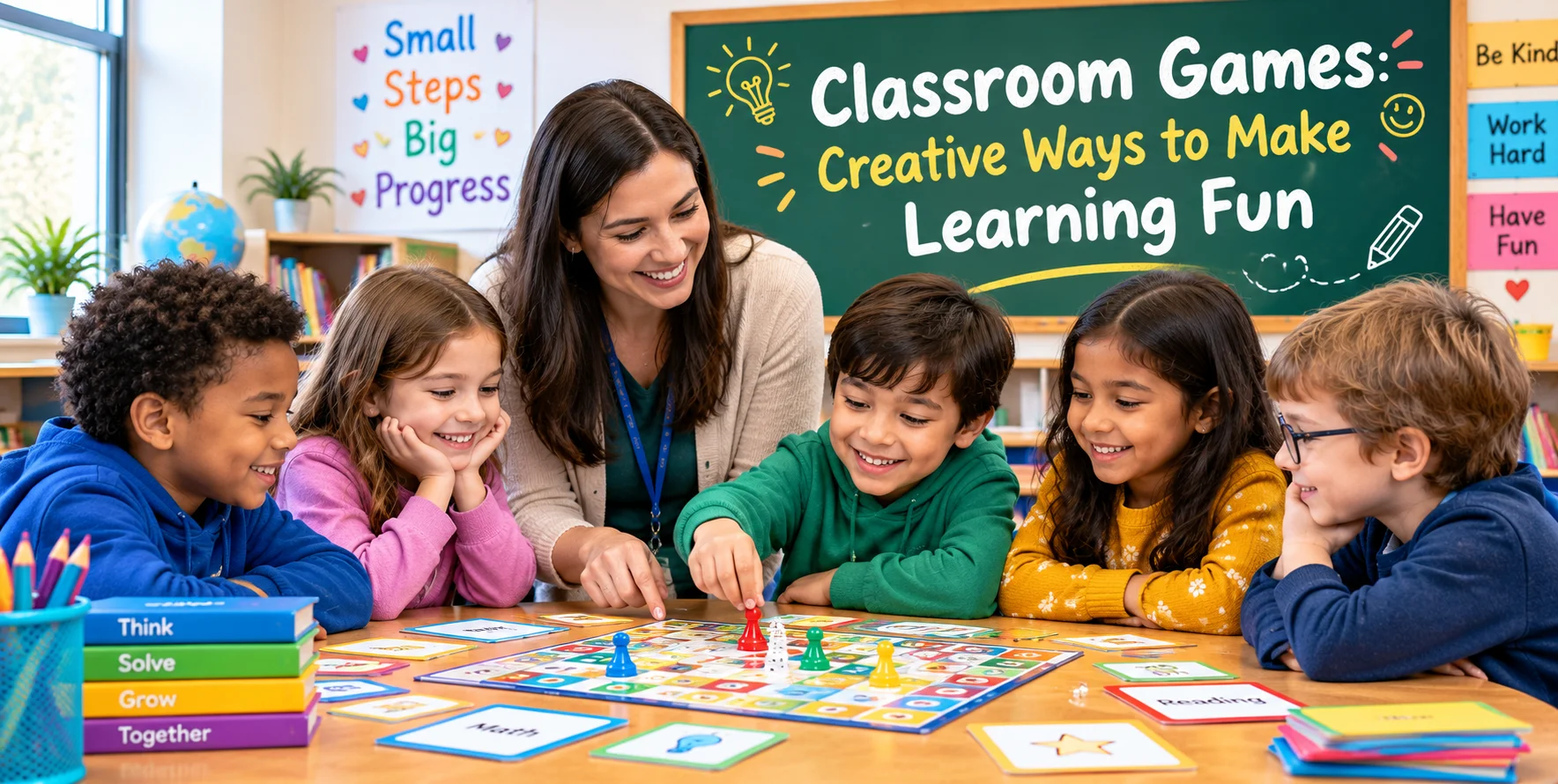
Learning does not have to feel like a routine of textbooks, worksheets, and long lectures. Classroom Games can turn ordinary lessons into engaging experiences where students participate, communicate, solve problems, and enjoy the learning process. When used thoughtfully, educational games can support academic skills while also creating a positive and energetic classroom environment.
Teachers can use games for almost every subject, including mathematics, science, English, history, languages, and general knowledge. The best activities are simple to organize, connected to learning goals, and flexible enough for different age groups and abilities.
Why Classroom Games Make Learning More Engaging
Students often learn more effectively when they actively participate rather than simply listen. Classroom Games introduce movement, competition, creativity, teamwork, and quick decision-making into lessons. These elements can make challenging subjects feel more approachable.
Games can also create an opportunity for students to practice skills repeatedly without feeling that they are completing the same exercise again and again. A vocabulary game, for example, can encourage learners to recall words several times while keeping the activity enjoyable.
Another benefit is classroom interaction. Students may communicate with classmates, explain their answers, listen to different ideas, and work toward a shared objective. This makes games useful not only for academic learning but also for developing communication and collaboration skills.
Useful Classroom Games for Different Learning Goals
The most effective Classroom Games are connected to a clear purpose. Instead of choosing an activity simply because it looks entertaining, teachers can decide what students should practice and then select a game that supports that goal.
| Classroom Game | Main Skill | Best Use | Student Benefit |
| Quiz Challenge | Recall and knowledge | Reviewing lessons | Builds memory and confidence |
| Word Chain | Vocabulary and language | English or language classes | Improves word recognition |
| Math Relay | Calculation and problem-solving | Mathematics practice | Encourages speed and teamwork |
| Mystery Box | Reasoning and observation | Science or general subjects | Develops curiosity |
| Classroom Bingo | Recognition and recall | Revision activities | Makes repetition more engaging |
| Team Debate | Communication and reasoning | Social studies or English | Builds speaking skills |
| Charades | Vocabulary and expression | Languages and literature | Encourages creativity |
| Puzzle Race | Critical thinking | Review and enrichment | Develops problem-solving |
Teachers can modify these activities according to students’ ages, classroom size, and available time. Even a five-minute activity can provide a useful change of pace during a lesson.
1. Quiz Challenge
A quiz challenge is one of the easiest activities to introduce. The teacher can prepare questions based on the current lesson and divide students into small teams. Each team earns points for correct answers.
Questions can include multiple-choice prompts, short answers, true-or-false statements, or visual clues. Teachers can also add a bonus question at the end to create excitement.
2. Word Chain
Word Chain works particularly well in English and language classes. One student says a word, and the next student must provide another word based on an agreed rule.
For example, students might need to provide a word beginning with the final letter of the previous word. More advanced versions can require vocabulary from a specific topic, such as science, travel, animals, or literature.
3. Math Relay
Math Relay transforms calculation practice into a collaborative challenge. Students work in teams and solve a sequence of problems. Once one student completes a problem, another team member continues with the next one.
The activity can include addition, subtraction, multiplication, fractions, percentages, geometry, or algebra depending on the class level.
4. Mystery Box
A Mystery Box activity can introduce an element of curiosity. The teacher places an object, picture, clue, or question inside a box and asks students to identify it through hints.
This game can be adapted for science experiments, vocabulary lessons, history topics, or general knowledge. It encourages students to observe information carefully and make logical connections.
5. Classroom Bingo
Bingo does not have to focus only on numbers. Teachers can create cards containing vocabulary, definitions, mathematical answers, historical events, scientific terms, or lesson concepts.
Instead of calling out the exact word, the teacher can provide a clue or definition. Students then identify the correct answer on their cards.
How to Choose the Right Classroom Game
Choosing the right activity begins with the learning objective. A vocabulary lesson may benefit from a word game, while a mathematics lesson may require puzzles or calculation challenges.
Teachers should also consider class size. A game that works well with ten students may need adjustments for a class of thirty or more.
Age and ability matter as well. Younger learners may respond well to movement and visual activities, while older students may prefer debates, strategy games, puzzles, and problem-solving challenges.
Finally, consider time. A short five-minute game can be useful as a lesson starter or review activity, while a larger team challenge may require an entire class period.
How Classroom Games Support Different Skills
A well-designed game can teach several skills at the same time. While the primary goal may be academic revision, students can also develop social and cognitive abilities.
Communication Skills
Team-based activities encourage students to explain answers and share ideas. This can help learners become more comfortable speaking in front of others.
Critical Thinking
Puzzles, mysteries, debates, and problem-solving challenges require students to examine information before reaching a conclusion. This develops analytical thinking rather than simple memorization.
Teamwork
Group games teach students how to divide tasks, listen to teammates, and cooperate toward a common goal. These skills can become valuable beyond the classroom.
Memory and Recall
Quick quizzes and review games give students repeated opportunities to retrieve information. Regular recall can make revision more active and memorable.
Creativity
Activities such as charades, storytelling challenges, drawing games, and role-based exercises allow students to approach a topic from different perspectives.
Creative Ideas for Making Classroom Games Better
Teachers do not need expensive equipment or complicated technology to create effective activities. A few simple adjustments can make familiar games feel fresh and exciting.
Use Real Lesson Content
The strongest games are connected directly to the lesson. If students are studying fractions, for example, the game should give them opportunities to work with fractions rather than simply provide unrelated entertainment.
Keep Rules Simple
Students should understand how the activity works before it begins. Complicated rules can consume valuable lesson time and distract learners from the educational goal.
Give Everyone a Chance
Competitive activities can be enjoyable, but every student should have an opportunity to participate. Teachers can rotate roles, create small teams, or include individual challenges so that quieter students are not overlooked.
Add Time Challenges Carefully
A countdown can create energy, but excessive pressure may make some learners uncomfortable. Short, manageable time limits can provide excitement without becoming the main focus of the activity.
Reward Progress
Rewards do not always need to be physical prizes. Teachers can recognize teamwork, improvement, creativity, accurate explanations, or persistence. Positive recognition can motivate students to remain involved.
Classroom Games for Different Subjects
The versatility of Classroom Games makes them useful across the curriculum. A single game format can often be redesigned for completely different subjects.
English and Literature
Teachers can use vocabulary races, story-building challenges, character guessing games, spelling competitions, and word puzzles. These activities can strengthen vocabulary, comprehension, grammar, and communication.
Mathematics
Math Bingo, equation races, number puzzles, mental calculation challenges, and geometry matching games can make practice sessions more interactive.
Science
Science classes can include mystery-object activities, classification challenges, diagram puzzles, experiment prediction games, and terminology quizzes.
History
Timeline races, historical character guessing games, event-matching activities, and team quizzes can help students organize important information.
Geography
Map challenges, capital-city quizzes, landmark guessing games, and country matching activities can turn geographical facts into interactive exercises.
Tips for Managing Games in a Busy Classroom
Successful educational games require some classroom organization. Before starting an activity, teachers should explain the objective, rules, time limit, and expected behavior.
It is also helpful to prepare materials in advance. Cards, questions, worksheets, markers, or digital displays should be ready before students begin.
Teachers should monitor participation during the activity. If one student dominates a team, roles can be rotated so everyone contributes. Similarly, if competition becomes too intense, the focus can be shifted toward teamwork and learning.
Another useful strategy is to finish the game with a short review. Asking students what they learned or which questions were difficult connects the fun activity back to the lesson.
Benefits of Using Classroom Games Regularly
Using Classroom Games occasionally can make a lesson more enjoyable, but regular use can create a broader learning routine. Students may become more comfortable participating and taking academic risks.
Five important benefits include:
- Higher engagement: Games can capture attention and encourage active participation.
- Better collaboration: Team activities give students opportunities to communicate and cooperate.
- Stronger recall: Repeated practice through games can reinforce important information.
- Greater confidence: Students can practice skills in a relaxed and interactive setting.
- More creative learning: Games allow teachers to present familiar topics in fresh and memorable ways.
The goal is not to turn every lesson into a competition. Instead, games should complement explanations, discussions, practice exercises, projects, and other teaching methods.
Frequently Asked Questions
1. Why are Classroom Games useful?
Classroom Games can make lessons more interactive while giving students opportunities to practice knowledge, communication, teamwork, and problem-solving.
2. Can Classroom Games be used for serious subjects?
Yes. Games can be adapted for mathematics, science, history, languages, geography, and many other subjects when they are connected to specific learning goals.
3. Do Classroom Games need technology?
No. Many effective games require only paper, cards, a whiteboard, classroom objects, or questions prepared by the teacher.
4. How long should a classroom game last?
It depends on the activity. Short games can take five to ten minutes, while larger team challenges may last twenty to thirty minutes.
5. How can teachers make games educational?
Teachers should connect each game to a clear lesson objective and include questions, tasks, or challenges that allow students to practice the knowledge or skill being taught.
Final Thoughts
Classroom Games can transform ordinary learning activities into engaging opportunities for participation, practice, and discovery. They give students a chance to communicate, solve problems, remember important information, and work with classmates in a positive environment.
The most effective approach is to choose games with a clear educational purpose rather than using activities simply to fill time. With simple rules, thoughtful preparation, and inclusive participation, teachers can create memorable lessons without needing expensive resources.





One thought on “Classroom Games: Creative Ways to Make Learning Fun”