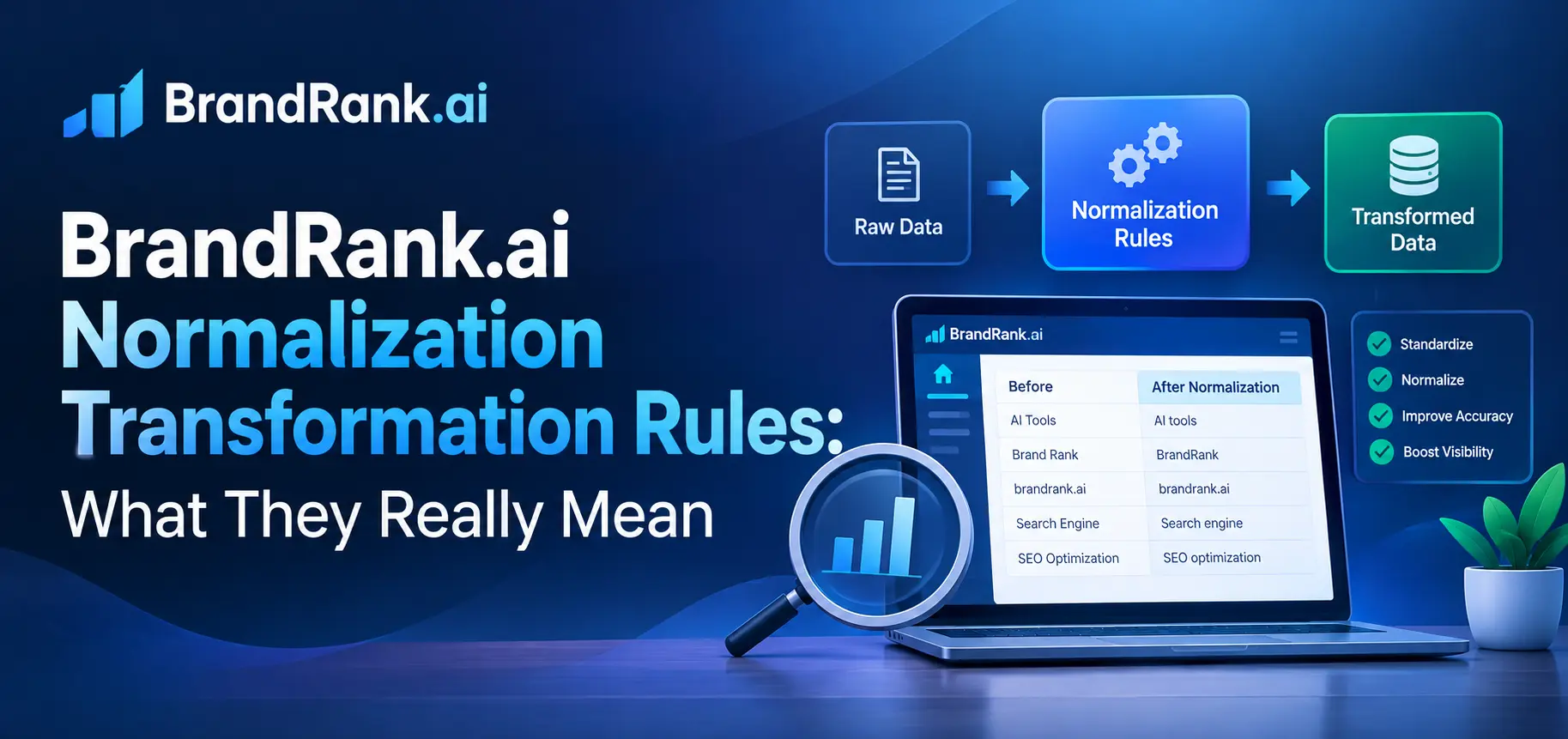
BrandRank.ai Normalization Transformation Rules: What They Really Mean
If you searched for BrandRank.ai normalization transformation rules, you probably expected a clean technical document with a numbered list of rules. Here is the honest picture: BrandRank.ai is a real company and normalization is a real data practice, but no official rule book with this exact name seems to be published. The phrase is mostly used as shorthand.
That does not make the topic useless. The idea behind it is practical, and it can help anyone who manages brand names, URLs, and product data. This guide explains what the phrase usually means, how normalization works step by step, where it goes wrong, and how to apply it to your own data. You will also find a comparison table, a worked example, and a short FAQ.
What Do BrandRank.ai Normalization Transformation Rules Actually Refer To?
Let’s be clear about what is and is not known. BrandRank.ai is an AI search visibility company. Its public material talks about testing prompts, tracking brand mentions, and checking how readable a site is for AI systems. It does not publish a technical specification called “normalization transformation rules.”
So when you see this phrase in blog posts, treat it as a label for a general practice: cleaning and standardizing brand information so that machines read it as one consistent thing. It is not a secret formula, and nobody outside the company can tell you its internal settings. Be careful with any article that claims otherwise.
What BrandRank.ai Does and Why Data Consistency Matters
AI tools like ChatGPT, Gemini, and Perplexity now answer questions about brands directly. Platforms such as BrandRank.ai exist to measure how a brand appears in those answers. That work depends on clean data. If a company shows up as “Acme Ltd,” “ACME,” and “acme.com” in different places, a system may treat them as three separate entities or struggle to connect them.
Normalization is the step that reduces that confusion. It does not change what a brand is. It changes how consistently the brand is written down.
What Is Normalization in Simple Words?
Normalization means converting different versions of the same information into one agreed form. Transformation means reshaping that information into the fields a system needs, such as name, URL, category, and description.
Think of the contact list on your phone. If one person is saved as “Ali Khan,” “alive khan,” and “Ali Khan ” with an extra space at the end, your phone may show three contacts. Merging them into one clean entry is normalization. The person did not change. Only the record did.
How the Normalization Process Works
A normalization system starts with raw information and applies defined rules to produce a standard version. The process usually has four stages.
Input Collection
The first stage is collecting raw information from a source, such as brand names, website URLs, product names, descriptions, and categories. At this point the data may contain inconsistencies that still need to be handled.
Cleaning the Data
Cleaning removes formatting or characters that add no meaning, such as extra spaces, inconsistent punctuation, or unnecessary URL parts. Small differences matter a lot when large datasets are compared automatically.
Applying Transformation Rules
Predefined rules then reshape the cleaned data. A rule might decide how capital letters are treated, how punctuation is handled, or how an identifier should be written. The key point is that the same rule should give the same result for similar inputs.
Creating a Standard Representation
The final stage produces one standardized version instead of many similar ones. This makes later processing easier and supports more reliable matching.
Common Types of Normalization Rules
Most rule sets are built from a few basic categories. Each one solves a different kind of mess.
Case Normalization
This converts text to a common case, usually lowercase, so “BRANDRANK.AI” and “brandrank.ai” match. It works well for domains and search matching, but be careful with official brand names where capital letters are part of the style.
White space Normalization
Extra spaces, tabs, and line breaks make identical text look different to a computer. This rule trims the ends and collapses repeated spaces into one.
Punctuation Handling
Periods, hyphens, and underscores vary a lot between sources. Sometimes they are noise, and sometimes they matter. The dot in “brandrank.ai” is part of the domain, while a stray comma at the end of a name is not. Never strip punctuation blindly.
URL Normalization
The same page can appear with or without a trailing slash, with tracking parameters, or in different letter cases. A URL rule decides which parts to keep. Removing a tracking tag like ?source=web is usually safe. Removing a parameter that selects a specific product page is not.
Unicode Normalization
Some characters look identical but are stored differently, especially in text copied from different platforms or written in other languages. Unicode normalization makes these consistent so equal-looking text is treated as equal.
Normalization Examples at a Glance
The table below shows how common raw inputs might be handled. The exact output always depends on the rules you choose.
| Raw Input | Possible Normalized Form | Main Issue |
|---|---|---|
| BRANDRANK.AI | brandrank.ai | Capitalization |
| BrandRank.ai | brandrank.ai | Capitalization |
| brandrank.ai/ | brandrank.ai | Trailing slash |
| brandrank.ai?source=web | brandrank.ai | Tracking parameter |
| BrandRank AI | Depends on your rules | Extra space and separator |
Notice the last row. “BrandRank AI” with a space could be the same brand as the domain, or it could be a different entity. A good rule set marks this as a case to review instead of guessing.
A Real-World Example: One Brand, Five Spellings
Imagine a small business called Blue Harbor Coffee. Its details appear like this across the web:
- “Blue Harbor Coffee” on its own website
- “BLUE HARBOR COFFEE” on a business directory
- “Blue Harbour Coffee” on a review site (a spelling variation)
- blueharborcoffee.com/ in a social media bio
- blueharborcoffee.com?ref=ig from an Instagram link
Here is how a careful process would handle it:
- Pick a canonical name. Decide that “Blue Harbor Coffee” is the official version.
- Normalize the domain. Convert both URLs to blueharborcoffee.com and drop the tracking parameter.
- Standardize casing. Treat the uppercase directory entry as the same name.
- Flag the spelling variant. “Harbour” is one letter off, so send it for a human check instead of merging it automatically.
- Record what changed. Keep the original value next to the cleaned one.
Four of the five entries are merged safely. The fifth is reviewed. That balance between cleaning and caution is the heart of the whole process.
Why Rules Need Clear Boundaries
A good normalization system must know what to change and also what to leave alone. Over-normalization is just as harmful as messy data. If two products differ by a single character and a rule treats them as identical, you get wrong associations.
Three principles help:
- Preserve meaning. If a change makes two genuinely different entities look the same, the rule is too aggressive.
- Stay predictable. The same input should always produce the same output, which makes rules easy to test and fix.
- Document exceptions. Some data needs special handling, so record those cases instead of forcing everything through one rule.
Why Consistent Brand Data Can Help AI Search Visibility
AI systems pull information from many pages. When your brand name, domain, description, and contact details match everywhere, there is less for them to reconcile. That can make your brand easier to recognize as a single entity.
Still, be realistic. Normalization does not guarantee a ranking or a mention in an AI answer. Visibility also depends on useful content, accurate facts, a solid technical setup, and trust signals from other sites. Think of consistency as a clean foundation, not a shortcut.
Practical places to keep things consistent include:
- Your website header, footer, and About page
- Structured data (schema markup) on key pages
- Social media profiles and business listings
- Canonical URLs and redirects
- Product and service names
Common Mistakes to Avoid
Poorly designed rules can create new inconsistencies. Watch out for these:
- Removing meaningful characters in model numbers, versions, and domains.
- Merging lookalike names that belong to different entities.
- Applying rules unevenly across parts of the same dataset.
- Ignoring exceptions that real data always contains.
- Not keeping a record of the original value, which makes mistakes impossible to undo.
A Simple Five-Step Workflow
- Collect the raw brand data from your site, profiles, and listings.
- Inspect it for variations, duplicates, and formatting differences.
- Define your rules and write down the preferred format for each field.
- Test on a small sample that includes odd cases, special characters, and duplicates.
- Review the output regularly and update the rules when real exceptions appear.
A spreadsheet is enough to start. You do not need special software to fix inconsistent names and links on a small or medium website.
Frequently Asked Questions
Is there an official BrandRank.ai normalization rule book?
No public specification with that exact name appears to exist. BrandRank.ai is a real AI search visibility company, but the phrase is best understood as a general description of data standardization, not a published document.
Why are normalization rules important?
They create consistent versions of information and reduce needless differences between similar records, which improves matching and data quality.
Does normalization change the original meaning?
It should not. Good rules standardize how information is written while preserving what it means. If a rule changes meaning, it is too aggressive.
Can URLs be normalized safely?
Yes, for elements like trailing slashes, letter case in the domain, and tracking parameters. Be careful with parameters that change which page or product is shown.
Will normalization improve my Google or AI search rankings?
Not by itself. It supports cleaner, more consistent information, but rankings depend on content quality, technical health, and trust signals.
Final Thoughts
The keyword BrandRank.ai normalization transformation rules points to a useful idea wrapped in vague wording. There is no hidden official rule book, but the practice behind it is solid: write your brand information the same way everywhere, clean up avoidable variations, and be careful not to merge things that are genuinely different.
Start small. Choose one official brand name, one preferred URL format, and one description. Test your rules on a sample, keep the original values, and review the results. Consistent, honest, well-documented data will serve both your readers and the systems that read your site.