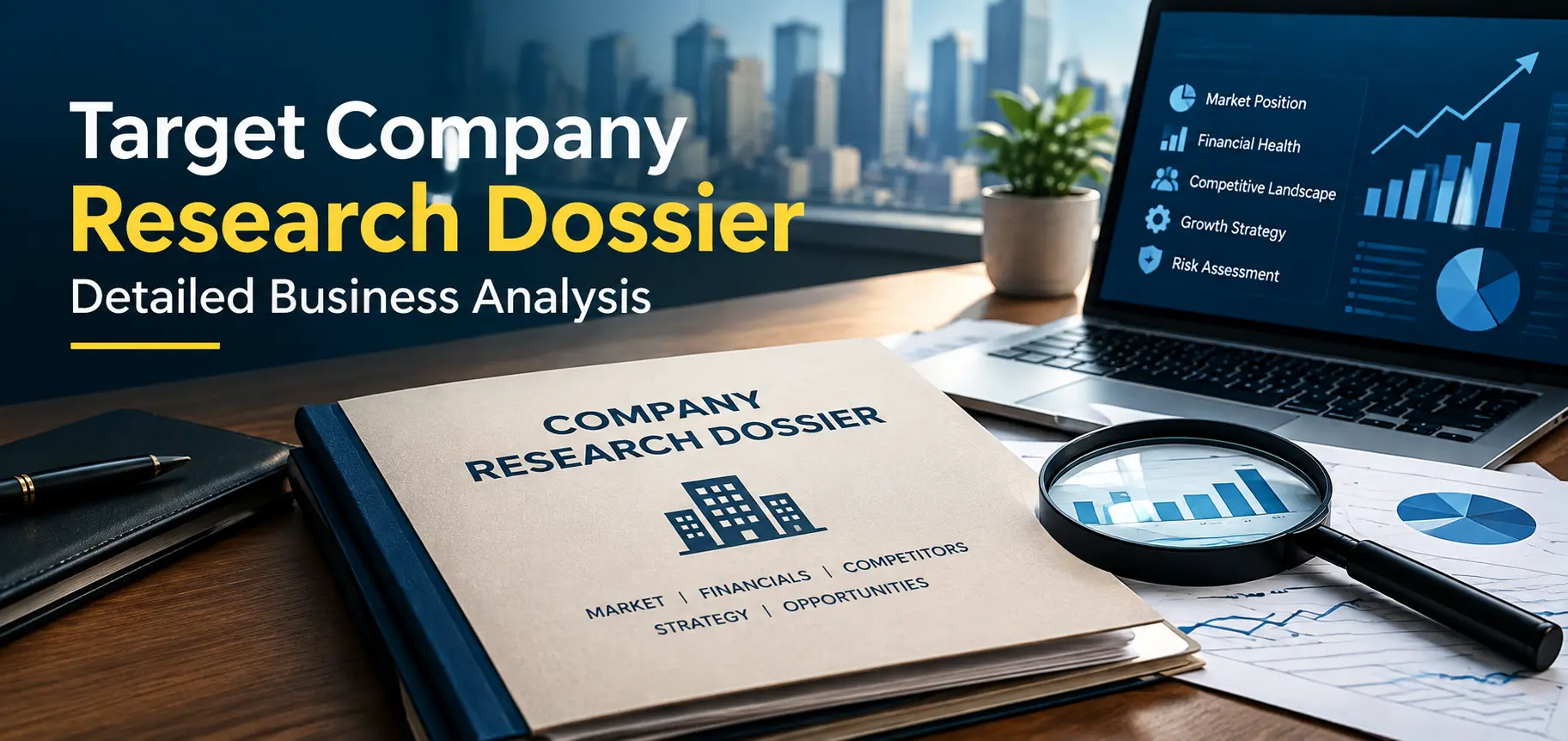
A research dossier for target company is a structured way to collect, organize, and evaluate important information about a business before making a professional decision. Whether the goal is market research, competitor analysis, partnership evaluation, investment research, sales preparation, recruitment, or strategic planning, a well-built dossier turns scattered information into a useful business picture.
Instead of relying on a company website or a few online mentions, a detailed research dossier examines the organization from multiple angles. This can include its history, products, customers, leadership, market position, financial indicators, competitors, digital presence, reputation, risks, and future direction.
The real value comes from connecting these findings. A company may have strong products but face intense competition. Another may have rapid growth but depend heavily on a small number of customers. Looking at several dimensions together creates a clearer and more balanced understanding.
Understanding the Purpose of a Company Research Dossier
A business dossier should begin with a specific research objective. Without a clear purpose, research can quickly become a collection of unrelated facts.
For example, a sales team researching a potential business customer may focus on company size, decision-makers, recent expansion, technology adoption, and business challenges. An investor may pay closer attention to revenue trends, ownership, debt, market conditions, and competitive pressure.
The same target company can therefore require different research depending on the intended use.
A strong dossier should answer practical questions such as:
- Who operates the company?
- What products or services generate its business activity?
- Who are its main customers?
- Which markets does it serve?
- How does it compare with competitors?
- What recent developments could affect its direction?
- Which risks deserve further investigation?
These questions create a framework that keeps research focused.
Key Areas to Investigate
Company Background and History
Begin with basic corporate information. Record the company’s founding date, headquarters, ownership structure, major milestones, subsidiaries, and important changes over time.
Company history can reveal patterns that are easy to miss in a current snapshot. Acquisitions may indicate expansion into new markets, while leadership changes can signal a shift in strategy.
Use primary sources whenever possible, including official corporate pages, regulatory records, annual reports, investor documents, and verified public filings.
Products, Services, and Business Model
Next, examine how the company creates and delivers value.
Identify its main products or services and determine which customer groups they serve. Look at pricing structures where reliable information is available, distribution channels, recurring revenue models, licensing arrangements, subscriptions, or other relevant commercial structures.
It is also useful to distinguish between the company’s core business and newer initiatives. A business may publicly highlight an emerging product while most of its current activity still comes from established offerings.
Leadership and Organizational Structure
Leadership research can provide important context about business priorities.
Document senior executives, founders, board members, and other relevant decision-makers. Pay attention to professional backgrounds and publicly documented responsibilities rather than relying on assumptions.
Leadership changes should also be recorded with dates and reliable sources. A new chief executive, major restructuring, or change in ownership may influence strategic priorities.
Market and Customer Analysis
A target company does not operate in isolation. Its position depends on customers, suppliers, competitors, regulations, and broader market conditions.
Identify the company’s primary customer segments and geographic markets. Then investigate the size and direction of the relevant industry.
Customer concentration can also matter. If a company depends significantly on a limited group of clients, that relationship may deserve closer examination.
Building a Research Dossier for Target Company
A useful dossier should separate verified information from interpretation.
Start with factual material such as corporate records, official announcements, published financial information, product documentation, and credible industry reports. After collecting the evidence, analyze patterns and possible implications.
Research Sources
Different sources provide different levels of reliability. Primary documents should generally receive greater attention when they directly address the subject being researched.
Useful sources can include company websites, government databases, securities filings, annual reports, reputable business publications, industry associations, court records where publicly accessible, professional networks, and established research databases.
Search results and social media posts can help identify leads, but important claims should be checked against stronger evidence before being included as established facts.
Competitor Research
Competitor analysis should go beyond listing company names.
Compare businesses according to relevant factors such as market focus, product range, geographic coverage, pricing approach, distribution, customer segments, technology, and visible strategic priorities.
The objective is not simply to identify the largest competitors. Smaller or specialized businesses may create significant pressure in a particular segment.
Five Essential Checks Before Finalizing Research
- Verify important claims: Cross-check significant information against reliable and preferably primary sources.
- Track dates carefully: Separate current developments from older events that may no longer represent the company.
- Identify information gaps: Clearly mark areas where reliable public evidence is unavailable.
- Separate facts from analysis: Explain when a statement is documented and when it represents an interpretation of the available evidence.
- Record source details: Keep the publication name, document title, date, and relevant reference so findings can be reviewed later.
Financial and Operational Signals
Financial research can provide another important layer of context. Depending on the type of company, examine revenue trends, profitability, cash position, debt, funding activity, major investments, and other publicly available indicators.
Not every company publishes detailed financial information. Private businesses may provide considerably less data than publicly listed organizations. In such cases, avoid presenting estimates as confirmed facts.
Operational indicators can also be valuable. Hiring activity, office expansion, product launches, geographic growth, partnerships, and technology investments may reveal business priorities.
However, each signal should be interpreted carefully. For example, increased hiring can indicate expansion, but it can also reflect restructuring or the replacement of departing employees.
Reputation, Digital Presence, and Public Perception
A detailed company dossier should also consider how the business appears across public channels.
Review the official website, professional profiles, press coverage, customer feedback, industry discussions, and public announcements. Look for recurring themes rather than isolated comments.
Reputation research requires particular care because online reviews and public discussions can contain incomplete or highly subjective accounts. A useful dossier should distinguish documented events from individual opinions.
Digital presence can also reveal strategic priorities. A company frequently publishing technical material may be focused on thought leadership, while another that regularly announces partnerships may emphasize ecosystem development.
Example of a Target Company Research Dossier
Consider a fictional technology company called NovaGrid Systems.
Suppose research shows that NovaGrid provides cloud infrastructure services to mid-sized businesses. Its website highlights rapid expansion, while public hiring information shows increased recruitment in engineering and customer support.
Further research identifies three established competitors, a recently announced regional expansion, and a partnership with a major software provider.
A useful dossier would not simply conclude that NovaGrid is growing. Instead, it would document each signal separately, identify the dates and sources, and explain that the combined evidence may indicate an expansion strategy.
This approach creates a more defensible research record and makes future updates easier.
Organizing Findings for Practical Use
A dossier becomes more valuable when another person can understand it quickly.
Use a consistent structure throughout the document. Start with an executive summary, followed by company background, products and services, leadership, market position, competitors, financial information, digital presence, risks, and source references.
A simple research matrix can help organize the most important findings:
| Research Area | Information to Collect | Useful Evidence |
|---|---|---|
| Company Profile | History, ownership, locations | Corporate records and official sources |
| Products | Main offerings and customer segments | Product pages and documentation |
| Leadership | Executives and key changes | Company announcements and filings |
| Market | Industry and competitors | Industry reports and business publications |
| Financial | Revenue, funding, profitability indicators | Financial reports and filings |
| Reputation | Public feedback and media coverage | Reputable publications and verified platforms |
The final document should prioritize information that supports the research objective rather than attempting to include every available fact.
Risks and Information Gaps
No public research dossier is complete without limitations.
Information can be outdated, incomplete, contradictory, or unavailable. Private companies may not disclose financial details. Ownership records can sometimes be difficult to interpret, while media coverage may focus heavily on major events and overlook routine operations.
Researchers should document these gaps instead of filling them with assumptions.
Risk analysis can cover regulatory exposure, competitive pressure, customer concentration, supply-chain dependence, leadership changes, cybersecurity incidents, litigation, market volatility, or reliance on particular technologies.
The relevance of each risk depends on the company and research purpose.
Keeping the Dossier Current
Business information changes quickly. A dossier prepared today may become outdated after a major acquisition, leadership change, product launch, funding event, or market disruption.
For ongoing research, establish a review schedule. High-priority companies may require monthly or quarterly updates, while less active projects may only need periodic reviews.
Each update should identify what changed rather than rewriting the entire document. This creates a useful timeline and makes strategic developments easier to track.
Final Thoughts
A research dossier for target company provides a structured foundation for understanding a business through evidence, context, and careful analysis. Its strength comes from combining company information with market conditions, competitors, leadership, financial signals, reputation, and potential risks.
The most useful dossier is not necessarily the longest one. It is the one that answers the right questions, distinguishes facts from interpretation, documents its sources, and clearly identifies information that still needs verification.
Good research reduces uncertainty. When organized properly, it can turn scattered public information into a practical resource for business planning, market research, due diligence, and informed professional decisions.
FAQs
1. How long should a company research dossier be?
The length depends on the research objective and complexity of the target company. A focused dossier may be several pages, while detailed due diligence can require a much larger document.
2. Which sources should researchers use?
Official company documents, government records, regulatory filings, reputable publications, industry reports, and verified databases are useful starting points.
3. Should private companies be researched differently?
Yes. Private companies often disclose less financial information, so researchers should rely more heavily on corporate records, industry sources, public announcements, and clearly identified third-party evidence.
4. How often should a company dossier be updated?
For active research, monthly or quarterly reviews can help maintain accuracy. Major events should be added whenever they occur.
5. Can a dossier include unverified information?
Unverified information can be recorded as a lead or research point, but it should be clearly identified rather than presented as an established fact.